What Is Vitamin C?
Vitamin C is an antioxidant your body already relies on for collagen production, and topically, it's one of the most well-researched brightening ingredients in skincare. On an ingredient label, it shows up in a few different forms - most commonly as ascorbic acid (also called L-ascorbic acid), or as a more stable derivative like ascorbyl palmitate, sodium ascorbyl phosphate, or tetrahexyldecyl ascorbate.
The form it's in actually matters quite a bit. L-ascorbic acid is the most studied and the most potent, but it's also unstable - it oxidizes quickly when exposed to air and light, which is why so many vitamin C serums ship in dark, airtight bottles and still lose potency within a few months of being opened. At higher concentrations, it can also irritate sensitive skin. Derivatives like tetrahexyldecyl ascorbate give up a bit of that raw potency in exchange for a lot more stability and a gentler feel - the vitamin C still converts into an active form once it's absorbed into skin, it just holds up better sitting in the bottle and is far less likely to cause stinging or redness along the way.

Functionally, vitamin C is doing three things at once. It acts as an antioxidant, neutralizing the free-radical damage from UV exposure and pollution before that damage can break down collagen. It slows melanin production, which is what makes it useful against dark spots and uneven tone. And it supports the skin's own collagen synthesis - which is why sticking with it consistently tends to show up as firmer, more resilient-looking skin over time, rather than as an overnight change.
Which Skin Types Benefit Most from Vitamin C?
Vitamin C is one of the more broadly suited actives in skincare, though the right form and concentration still depend on your skin type. For normal, combination, and oily skin, it's very well tolerated as a daily antioxidant step, and over time it also helps soften the look of enlarged pores and uneven texture.
For dry or sensitive skin, starting with a stabilized derivative rather than pure L-ascorbic acid tends to be the smarter move - you still get the brightening and antioxidant benefits, just without the stinging or flushing a high-percentage ascorbic acid formula can trigger on a compromised barrier. It's also why vitamin C so often shows up paired with vitamin E in a formula: the two work synergistically, with vitamin E helping stabilize the vitamin C and adding its own antioxidant protection on top, so together they do more than either one manages alone.
For dullness, dark spots, or lingering post-blemish marks, vitamin C is one of the gentler brightening options out there, especially next to stronger actives like hydroquinone. And because it works through antioxidant protection rather than exfoliation, it layers easily into almost any routine - including alongside bakuchiol, which is exactly why the two turn up together in the same formula so often: bakuchiol takes care of cell turnover and collagen support, vitamin C handles brightening and free-radical defense, and between them they cover more ground than either ingredient would on its own.

How Whish Uses Vitamin C
Vitamin C shows up in Whish formulas as tetrahexyldecyl ascorbate - the stable, oil-soluble form, chosen specifically because it holds up well in a formula without needing the dark glass and rapid-turnover handling that pure L-ascorbic acid demands, and because it's gentler on skin that's also working with an active like bakuchiol in the same routine.
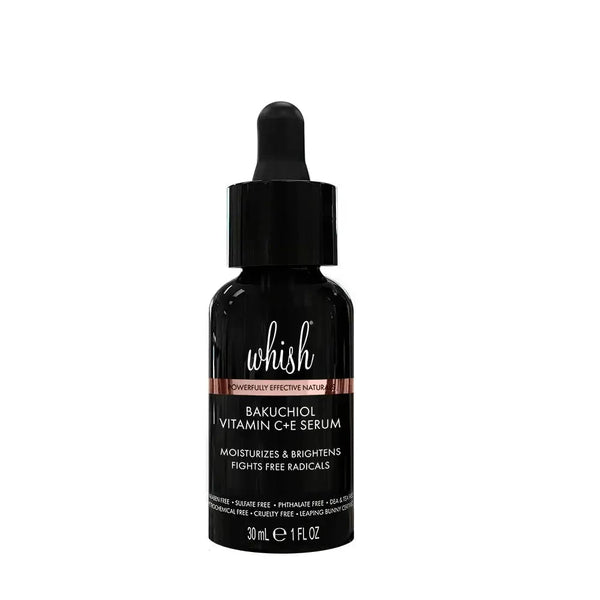
The Bakuchiol Vitamin C+E Serum is the clearest example of how it's put to use: vitamin C and vitamin E team up as the antioxidant, brightening layer, aloe vera and coconut water take care of hydration, and bakuchiol and hyaluronic acid handle fine lines and moisture retention - so one formula ends up doing the brightening, hydrating, and firming work you'd otherwise need three separate products for.
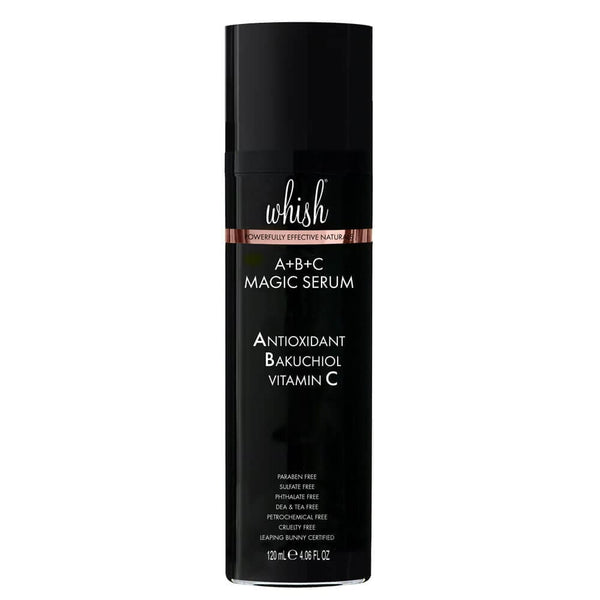
The A+B+C Magic Serum takes a similar approach and builds it out further: an antioxidant blend (the "A") for free-radical defense, bakuchiol (the "B") for fine lines and collagen support, and vitamin C (the "C") for brightening and tone. It's formulated as a lightweight, fast-absorbing serum that works on both face and body - which is a bit unusual for a vitamin C formula, since most are built with facial skin in mind only.
Vitamin E (as tocopheryl acetate) shows up alongside vitamin C in both formulas rather than standing on its own, which tracks with how the two are typically used in effective skincare - as a paired antioxidant system rather than as ingredients competing for the spotlight individually.
Explore the full serums collection or the skin care with bakuchiol collection to see where vitamin C fits in alongside Whish's other core actives.
How to Use Vitamin C Products for Best Results
Apply vitamin C serum to clean, dry skin, before your moisturizer and before SPF. Since it works as an antioxidant, it's most useful in the morning - that's when it can get ahead of the free-radical damage from UV and environmental exposure throughout the day, rather than showing up after the damage is already done. That said, it works just fine at night too, if that's where your routine has room for it.
Layer it under sunscreen, not in place of it. Vitamin C supports and boosts what SPF is already doing, but it's not a substitute for daily sun protection - the two work best together, with vitamin C mopping up the free radicals that get past sunscreen and everyday environmental exposure.

If you're combining vitamin C with bakuchiol in the same routine, reaching for a formula where both are already blended in - like the Bakuchiol Vitamin C+E Serum - is a lot simpler than layering two separate products, and it takes the guesswork out of which one goes on first. For an extra hydration boost before that, applying hyaluronic acid to damp skin first gives the serum something to actually seal in, instead of sitting on top of dry skin.
Give it time. Vitamin C's brightening effects build up gradually - most people notice a difference in overall radiance within a few weeks, with more visible improvement in tone and dark spots showing up over 8 to 12 weeks of consistent daily use, a timeline pretty similar to bakuchiol's.
All Whish formulas containing vitamin C are free from parabens, sulfates, and phthalates, and are cruelty-free and Leaping Bunny certified. Vitamin C is a genuinely useful, well-studied ingredient - it just needs the right form and a little patience to actually show what it can do.
Bakuchiol Vitamin C+E Serum